
The Dopamine Window: Why Post-Purchase Conversion Dies After 200ms
200ms delay killing your AOV? Discover how the Dopamine Window can turn a post-purchase high into a "Second Yes" before the clock runs out
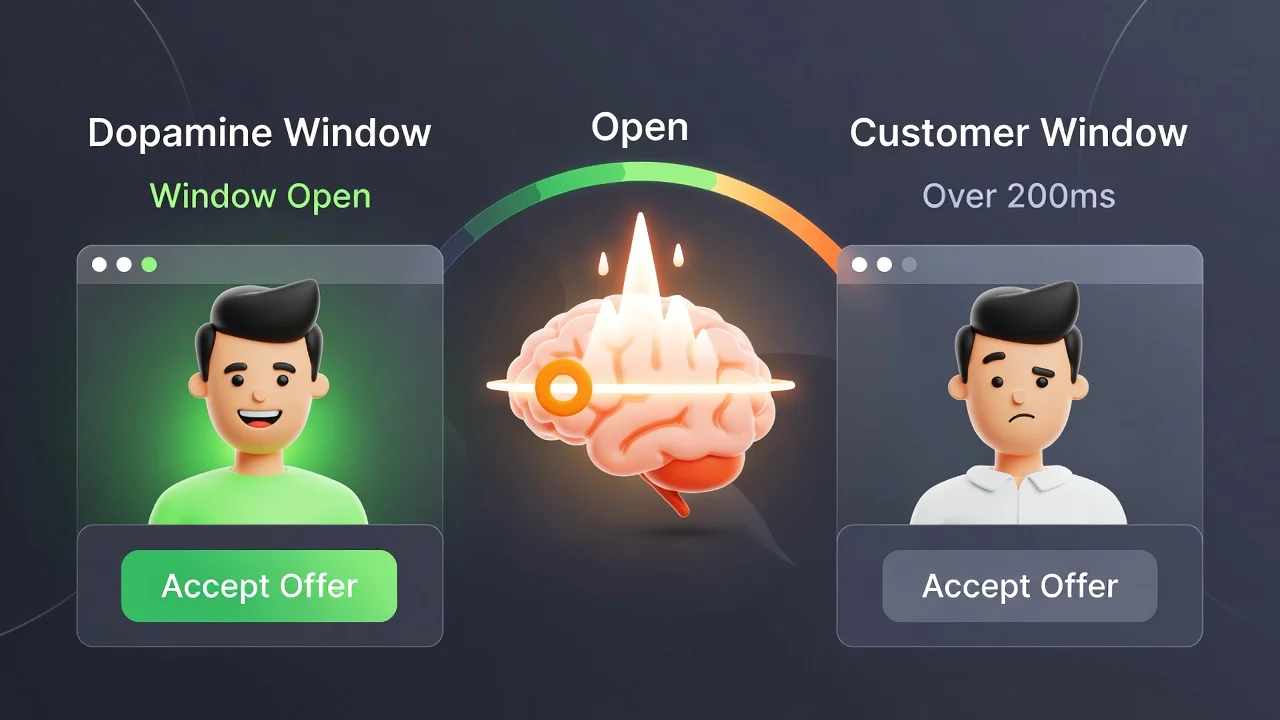
The moment a customer clicks Pay Now is one moment every Shopify merchant looks forward to. You’ve worked hard to acquire this customer and now that they finally said yes, you celebrate.
For most Shopify merchants, the story ends here and the post-purchase page becomes a polite “Thanks for your order.” But in 2026, that thinking is expensive. The post-purchase is now more than just a destination. It's a brief emotional window you can capture to boost your AOV.
Right after checkout, your customer is riding a short-lived emotional high filled with a burst of satisfaction, relief, and reward. Neuroscience calls this a dopamine spike. In ecommerce, it’s the most valuable 60 seconds in your entire funnel.
If your post-purchase experience appears instantly and flows without interruption, you keep that emotional momentum alive. But the moment your page hesitates, even for a fraction of a second, that momentum breaks. Speed is now the lever that lets you turn the dopamine window into real AOV growth.
The Neuroscience of the “Second Yes”
To understand how critical the moment after checkout is, we need to understand how the human brain makes decisions. Psychologists and behavioral scientists often describe decision-making using a simple framework of two systems:
- System 1
This is where the Buyer’s High lives. Here, the customer is emotional, intuitive, and impulsive.
When someone just completed a purchase, they are excited, and they feel good about their decision. It’s also where “Sure, why not?” happens when they see another relevant offer.
- System 2
This system is slow, logical, analytical, and budget-conscious. It asks uncomfortable questions like “Do I really need this?” or “Can I get this cheaper later?”
This is how both systems play out. A fast, seamless checkout experience keeps customers in System 1. And thanks to commitment bias, since they have said yes, they’re biologically inclined to stay consistent with that decision; that is, saying yes to a small relevant add-on feels natural.
This is why post-purchase upsells can outperform almost every other conversion tactic in ecommerce. But only if you protect the moment, and it doesn’t enter the friction pivot, where your checkout hesitates, and the upsell button takes too long to load.
At roughly 200 milliseconds, the brain is forced out of System 1 and into System 2. Instead of thinking about the product, the customer starts wondering if their payment went through or whether the platform is secure. That tiny delay breaks the dopamine loop. Once that happens, the buyer’s high evaporates and with it, your post-purchase conversion rate.
Why 200ms Is the Uncanny Valley of Ecommerce
While many Shopify stores aren’t slow in the obvious sense, the problem lives in the margin. Performance research has shown that delays don’t need to be long to be disruptive. They just need to be noticeable. Here’s how that plays out:
- Under 100ms feels instant and the brain doesn’t register a delay.
- Over 300ms feels slow. The user knows something is “loading.”
- Around 200ms is the point where the delay is just long enough to be felt, but not long enough for the user to understand why.
200ms is the Uncanny Valley of Speed. The brain labels it as uncertain and it triggers what is called the Micro-friction tax. The buyer simply disengages and the upsell feels more optional to them instead of being an easy yes.
This is why performance metrics like Interaction to Next Paint (INP) matter especially after checkout. INP measures how quickly the interface responds after a user interacts with it. On Shopify, anything above 200ms starts to feel sluggish, even if the page technically “works.” High INP breaks the buyer’s high the exact moment that trust matters most.
The “Native” Trust Signal
Speed keeps the Dopamine Window open, but visual continuity is what decides whether the customer trusts what they see inside that window. This is where many post-purchase strategies quietly fall apart. Right after checkout, customers are still mentally inside the Shopify experience which has a familiar flow. Their guard is down because everything feels official and expected.
Then legacy apps show up like uninvited guests. They load a fraction of a second late. They use slightly different fonts, buttons feel off, and spacing doesn’t match. Sometimes the layout even shifts after the page renders.
Nothing is technically broken, but to a customer who just paid, it creates instant cognitive dissonance. The upsell stops feeling like part of the order and starts feeling like an ad. That single moment of doubt is enough to snap them out of the buyer’s high.
That’s why native UI extensions outperform legacy pop-ups and iFrames during the post-purchase moment. They render directly inside Shopify’s checkout architecture and that offers two critical advantages during the Dopamine Window:
- They load instantly: Because they’re part of Shopify’s own rendering pipeline, they naturally stay under the 200ms INP threshold.
- They look official: They have the same design system and interaction patterns, so nothing feels visually “new” for the brain to question.
When an offer looks and behaves like part of the checkout, the customer doesn’t stop to evaluate intent. They follow through with it. The Dopamine Window stays intact because trust never breaks.
How to Win the Dopamine Window
In most cases, you only get one chance with the Dopamine Window, and then you lose it. And while speed and trust create the opportunity, it is strategy that determines whether you convert it. Here’s how smart Shopify merchants actually capitalize on that window.
- The 25% rule
Your post-purchase offer should cost no more than 25% of the original order value. Once a Shopify upsell crosses that threshold, it stops being a micro-decision and becomes a new purchase. New purchase decisions activate System 2 thinking, and once you trigger it, the window closes.
Let’s look at two examples:
- A $15 shipping protection add-on after a $60 order is an easy yes.
- A $50 “complete the set” offer after a $60 order? Now the customer is budgeting again, and you’ve just successfully pulled the customer out of the Buyer’s High.
Same timing. Same customer. But a very different brain state. While the Dopamine Window can support small, additive decisions, it collapses under big ones.
- Low-cognitive-load offers win every time
Price matters less than mental effort. Some offers are naturally easy to say yes to because they don’t ask the customer to imagine, compare, or configure anything. Others ask the customer to mentally work and that’s where conversion dies.
Examples of low-cognitive-load offers:
- Shipping protection
- Priority fulfillment
- Extended warranty
Examples of high-cognitive-load offers:
- “Add these three products in your preferred color and size.”
- “Customize your bundle”
- “Choose between multiple variants”
These offers aren’t bad on their own, but for a post-purchase offer, they are mistimed. The moment the customer has to think, you’ve already lost them. During the Dopamine Window, simplicity keeps the momentum alive, while complexity kills it.
The Performance Audit
If you want to be brutally honest about whether your upsells are helping or hurting, Shopify already gives you the answer. Go to your Shopify Admin → Web Performance dashboard.
Focus on the Interaction to Next Paint (INP) on checkout and post-purchase pages. If that number is above 200ms, your upsell tools are actively costing you money.
Here’s a simple test that surprises a lot of merchants:
- Disable your upsell app for one day
- Watch what happens to checkout abandonment
- If abandonment drops, you just found your friction point
At that stage, the solution is not to tweak your offers. It’s to switch to tools that operate inside Shopify's performance sandbox. Native UI extensions like Cart-X run inside Shopify’s performance sandbox. That’s why merchants often see improvements not just in speed scores, but in actual acceptance rates within days.
The 2026 Strategy: Optimize for Momentum
If you want to grow AOV in 2026, stop thinking about apps as feature sets. Start thinking about them as potential friction points.
Here’s a simple strategy that works:
- Audit your INP: If your post-purchase page takes more than half a second to respond, you’re training customers to hesitate.
- Shorten the path: Use native, one-click upsells. Every extra click is another chance for the Dopamine Window to close.
- Protect the high: Every millisecond matters. If you can’t deliver the offer instantly, you’re better off not showing it at all.
Conclusion: Performance Is a Sales Strategy
As a Shopify merchant in 2026, you need to understand how your customers’ psychology works. While spending money on new tools and tweaking offers can seem to work temporarily, fixing your tech stack holds more benefits.
The highest-performing Shopify merchants are winning because they have mastered the art of delivering offers that arrive at the right moment without causing friction and delay.
Cart-X is built for this moment: it runs natively inside Shopify’s checkout to ensure your post-purchase offers load instantly. By staying well under the 200ms threshold, we keep the experience seamless exactly when the buyer’s intent is at its peak.
The Dopamine Window closes fast, but Cart-X architecture ensures you never miss it. Our merchants consistently see sub-200ms load times and 10–15% post-purchase conversion rates. This is the new standard for high-performance commerce: fast checkout, higher AOV, and zero trade-offs.
Ready to recover your ghosted revenue? Start your free Cart-X trial today and see how native, agentic upsells transform your AOV.
The Dopamine Window: Quick FAQ
What is the Dopamine Window?
It is the 60-second peak immediately after checkout. Trust is high, and the brain is biologically primed for reward-seeking. Friction or delay closes this window instantly.
Why is the 200ms threshold critical?
Under 200ms, the brain stays in System 1 (intuitive/impulsive) mode. Once you cross that line, the customer shifts to System 2 (analytical/skeptical) mode. Speed keeps the buyer in a Yes state.
How do I audit my speed?
Check your Interaction to Next Paint (INP) score in the Shopify Web Performance dashboard. If your score exceeds 200ms, your current upsell tools are costing you revenue.
What is the Golden Rule for upsell pricing?
Keep offers under 25% of the original order value. This keeps the add-on in the micro-decision category rather than triggering a full budget review.
Why are Native UI Extensions superior to popups?
Native extensions are part of Shopify’s core architecture. They are unblockable and flicker-free. Popups create cognitive dissonance: if it looks like an ad, the customer snaps out of the buyer's high.
Don't miss out on expert e-commerce and marketing insights! Subscribe to our newsletter for valuable tips in just a few clicks.

.svg)


