
The Psychology of One-Click Upsells: Why Removing Friction Increases Conversions by 340%
Traditional upsells kill momentum. One-click changes everything. Here's the psychology behind why frictionless offers convert 340% better.

Shopify merchants are waking up to where real money lies in ecommerce. This space is between the purchase and the confirmation page, right after the customer places the order where the post-purchase upsell happens. For many, this is the perfect spot to increase AOV and rake in more revenue. But there is friction. Traditional upsells require customers to start a whole new buying process right after finishing one.
But there’s a better way: one-click upsell. The OCU automatically removes friction by using a stored payment and shipping info, to allow customers to add complementary products to their existing orders with a single tap.
This works like magic and increases conversion rates jump dramatically. While the average pre-purchase upsell converts around 2–5%, one-click post-purchase offers commonly convert between 15% and 35%.
Let’s explore how one-click upsell eliminates friction from a psychological standpoint. We’ll cover the surprising mindset customers enter right after buying, and show you how to use one-click upsells to lift revenue without touching your ad spend.
The Anatomy of Friction and the Power of “One Click”
Before we talk about why one-click upsells work, let’s discuss the one thing that destroys conversions in almost every Shopify store today: friction.
What is E-commerce Friction?
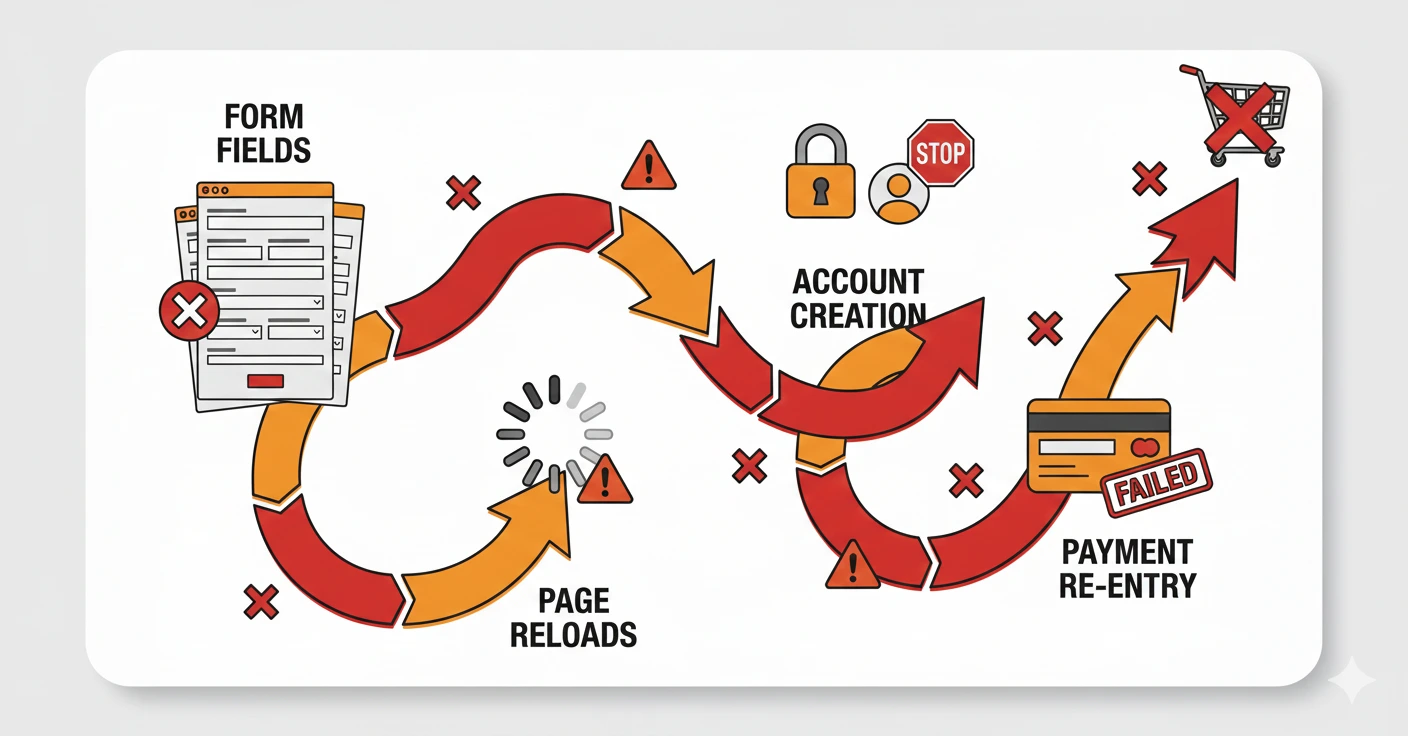
In ecommerce, friction is anything that makes buying harder. Sometimes, it can be obvious, such as needing to create an account just to check out. In other cases, it is subtler, like when a page reload takes longer than expected. Either obvious or subtle, friction can break momentum, and the worst part is, it often happens at the point of sale.
On a practical level, below are some high-friction moments in ecommerce:
- Asking customers to re-enter payment info
- Sending them to a new checkout page
- Making them fill out extra forms
- Slow page loads or redirect loops
- Forcing account creation
- Loading new steps in the middle of their momentum
While each of these may look small, they all do the same thing: they overwhelm the customer at the exact moment they want things to feel easy. And that brings us to the psychological part.
The Psychological Cost of Friction
Friction has a psychological effect on the customer. Every time they see a new field, a page of form pop up on their screen, they are wondering, “Do I really want to keep doing this?” This comes from the mental effort it takes to process and complete a task. And when the cognitive load spikes, customers default to the simplest option, which is doing nothing.
The human brain isn’t great at juggling too many things at once. This is where decision fatigue shows up. The “7±2 rule” tells us our working memory can only hold a handful of pieces of information at any moment. The typical checkout page already has enough elements competing for attention. Add to that the traditional upsell which tasks the brain to make a decision. With more fields comes more thinking.
Then comes the pain of paying. Once a customer has already completed their purchase, asking them to restart the emotional process of spending money again is like asking them to run a second race after they have crossed the finish line. Many won’t just do it. And when it gets too overwhelming, you lose the customer to the path of resistance: closing the tab. And that’s why the conversion rates stay low.
The One-Click Solution: Bypassing the Barrier
A one-click upsell flips the entire psychological script. Customers don’t have to fill a new form or complete a second checkout. Hence the mental workload is reduced. The upsell offer appears when the initial order is completed. Here, trust is at its highest and resistance is low. And because the payment token is already securely stored, the customer doesn’t “buy again.” They simply add to their existing order in one click that processes payment instantly using the token from their original offer.
In their mind, it does not feel like a new purchase, but a completion. Here’s what it looks like in numbers:
This is what eliminating friction does. And it only gets more interesting when you look at the psychology powering it.
The Core Psychology Behind One-Click Upsell Success
There is a psychology behind why one-click upsells work. It is because one-click aligns with how the human brain makes decisions. When customers complete a purchase, four psychological levers activate at once. And when your upsell matches those levers, conversion follows naturally. Let’s break them down.
When these principles line up, the upsell feels natural, logical, and even helpful.
Principle 1: Commitment and Consistency (The "Foot-in-the-Door" Technique)
Once a person makes a purchase, their brain wants to stay consistent with that decision. In a nutshell, they already see themselves as a customer. This is the level called commitment and consistency. By clicking “Place Order,” the shopper essentially declared: “I believe in this product. I trust this brand. I’m willing to spend.” When you offer an upsell, the customer does not consider it as you trying to convince them to make another purchase. Instead, it feels like the continuation of a conversation.
Once committed, the customer is more likely to take actions consistent with that commitment. This is where upsell feels seamless. The initial purchase is the big yes. A small, relevant add-on is an easy follow-up yes.
Pro Tip:
Your first upsell should feel like a natural extension of what they just bought. If someone buys a coffee maker, offer them premium beans, not gardening gloves. If they buy a fitness band, offer them a digital workout guide, not a random candle.
Principle 2: The Anchoring Effect
The price of the main product sets the anchor. In simple terms, the customer judges new prices relative to the first price they saw. If a customer just spent $150, a $30 add-on feels small, even if it’s objectively not. It feels like a value-add instead of an extra expense.
This is why upsells work dramatically better after a purchase rather than before it. Because if you show the same $30 product before the main purchase, they judge it on its own, and that is a different psychology.
Principle 3: Reciprocity & the Post-Purchase Glow
There is a moment of relief a customer feels after placing an order. It is the feeling of the mental effort is over, and they are now expecting their purchase. At this point, they are in a receptive and positive mindset where they are more open to offers presented as rewards or thank-you. And if the upsell feels like a gift, for instance, a one-time offer, it activates the principle of Reciprocity.
Pro Tip:
Frame your upsell as appreciation:
"Thanks for your order! Here’s an exclusive add-on you can unlock only right now."
Principle 4: Loss Aversion and Urgency
People hate missing out more than they enjoy gaining something new. This instinct is called the Loss Aversion or Fear of Missing Out (FOMO), and the one-click upsell is the perfect place to activate it. This is because the customer knows that the offer is going to disappear if they decline, and they don’t want to lose something. Since the friction is so low, “why not?” impulse almost always wins.
The Data-Backed Impact: Beyond the 340%
Understanding the psychology behind one-click upsells is powerful, but merchants don’t make decisions on theory alone. They make decisions on numbers.
Most merchants think of upsells as a way to add a few extra dollars to an order. In reality, a one-click upsell can reshape your entire unit economics. It changes what each customer is worth. It changes how aggressively you can bid on ads. It changes how confidently you can scale.
This is where the 340% claim comes in.
Deconstructing the 340% Claim
The headline of this article promises a 340% increase, so let’s address it directly and honestly. In a real-world case study from Minion Training, The CEO reported a 340% increase in conversions in three months after switching to a funnel builder that included one-click upsells. While the OCU wasn’t the improvement they made, it was the final piece that unlocked compounding gains.
It’s important to understand what this means:
- The 340% lift wasn’t a single upsell converting at 340% more.
- It was the entire funnel from the checkout flow, upsells, and post-purchase sequence working together.
- And the one-click upsell was the lever that removed friction at the most valuable moment.
In a nutshell, a one-click upsell alone won’t 4x your business overnight. But when you remove friction from the upsell flow and align it with buyer psychology, you make your whole system more efficient. You protect the main checkout, increase AOV and create a smoother buying experience that customers actually enjoy.
The Metrics That Matter: AOV and Conversion Rate
Two numbers matter most in ecommerce: AOV and Conversion Rate. One-click upsells improve both, which is rare.
1. Average Order Value (AOV)
A one-click upsell boosts your revenue without raising your ad spend by increasing the value you get per customer. Let’s put that in numbers.
- Let’s say your AOV is $50.
- Your upsell offer is $25.
- And 20% of customers accept.
For those 20% of customers, AOV instantly jumps from $50 to $75. And since CAC stays the same, every accepted upsell widens your profit margin.
This is the kind of quiet, sustainable growth that merchants dream about.
2. Core Conversion Rate (CR)
Traditional pre-purchase upsells introduce distractions during checkout. A customer is ready to buy, and suddenly they’re hit with a new decision. Some convert, but many simply abandon.
A one-click upsell solves that. You secure the sale first. You increase revenue second. This shift alone protects conversion rates while increasing total revenue, which is a win on both sides of the equation.
Industry Benchmarks and Real-World Data
The difference between a traditional upsell and a one-click upsell is visible in industry data. A standard upsell that requires a customer to re-enter payment information or navigate a new checkout page typically converts in the low single digits.
In contrast, the frictionless nature of the OCU drives acceptance rates that are an order of magnitude higher. The following table uses data from various e-commerce platforms and case studies to illustrate the potency of the post-purchase, one-click model:
The one-click post-purchase model stands out for a simple reason: It’s the only upsell that removes friction entirely. The less work a customer has to do, the more likely they are to say yes. This is why every Shopify brand that wants to increase AOV without spending more on ads should move in this direction.
The Long-Term Win: Customer Lifetime Value (LTV)
The one-click does more than get extra dollars from every transaction, it transforms the customer's experience and improves their impression of your brand. When customers experience a smooth, post-purchase moment, they form a more positive association with your brand. That single interaction:
- Reduces buyer’s remorse
- Reinforces trust
- Increases the chance of repeat purchases
- Makes customers more receptive to future offers
- Strengthens loyalty and advocacy
In other words, a one-click upsell doesn’t just raise today’s revenue, it strengthens the relationship that fuels tomorrow’s revenue.
How to Build a High-Converting One-Click Upsell Funnel
A one-click upsell works beautifully, but what matters most is using an intentional and strategic system that is built to match your customer’s psychology of what they want and not just what you want to sell. Let’s break down the framework that top Shopify stores use.
1. The Golden Rule of Relevance
Relevance is the single biggest predictor of upsell success. Your upsell lives or dies by how relevant it is to the purchase that came before it. If the upsell doesn’t feel like a natural next step, the customer won’t take it. A good upsell on the other hand, feels like the store is reading the customer’s mind and solving the obvious even before the customer thinks of it.
Here are a few examples of best upsell combinations that consistently perform:
Perfect Fits:
- Buys a DSLR camera. Offer a high-speed memory card or extended warranty
- Buys a 30-day supplement. Offer a discounted 90-day supply
- Buys an e-book, Offer a video course or template bundle
The upsell should feel like completing the purchase, not starting a new one. If the customer already wants the main product, these add-ons feel logical and helpful.
A rule of thumb:
If you wouldn’t recommend it to a friend who just bought that item, don’t offer it as an upsell.
2. Offer Sequencing Strategy (The Funnel)
The highest-performing stores don’t stop at one offer. They build a short, clean sequence designed to maximize AOV without overwhelming the customer.
Offer 1: The Core Upsell
This is the highest-value, highest-relevance offer. It should be a product that is a natural, logical extension of the initial purchase. The price point can be substantial. 50–100% of the original purchase price is normal here.
Offer 2: The Downsell
If they say no, don’t let the funnel hit a dead end. Offer a smaller, lower-cost version or an alternative accessory. For example:
- Declined a 90-day supplement? Offer a 60-day supply.
- Declined a premium case? Offer a basic protective sleeve.
Downsells catch revenue that would otherwise slip away.
Offer 3: The Final Add-On
If the customer accepts Offer 1, or if they decline Offer 2, you can present a final, low-cost, high-impulse item. This should be a small, highly relevant item (e.g., a $5-$10 accessory or a small digital download). This final offer is a last attempt to maximize the AOV before sending them to the thank-you page.
3. The Perfect Upsell Presentation
Even a great offer fails when it’s badly presented. Fortunately, the best-performing upsells share the same simple traits.
- Clear, Short Copy
Explain the benefit in one or two sentences. Use a clear, high-quality image of the product. The customer is in a hurry; do not make them read a long sales letter.
Clean Visual
A crisp image of the product.
Nothing cluttered. Nothing confusing.
Simple Yes/No Choices
One-click upsells work because the choice is simple: Your CTAs should look like this:
- Accept: "Yes, Add This to My Order Now (One-Click Purchase)"
- Decline: "No Thanks, I'll Pass on This Exclusive Offer"
No-Risk Guarantee
Reiterate your money-back guarantee or return policy. For example, “Covered by our 30-day refund policy.” This reduces the customer's perceived risk, making the impulse decision easier.
Frictionless Processing
If you call it a one-click experience, then you must deliver on your word. For Cart-X users, use a dedicated OCU application that integrates directly with your payment gateway (e.g., Stripe, PayPal, etc.) to securely store the payment token and process the charge with a single API call. It securely uses the payment details already on file, keeping the entire experience seamless.
Conclusion: Friction Is Optional. More Revenue Doesn’t Have to Be.
One-click upsell transforms how Shopify merchants operate. It is when merchants start using customer psychology to their advantage. This works by understanding how the moment after checkout can be the most profitable second system in your entire store. By building on this system with some best practices, your store can achieve higher AOV and a checkout experience that feels good for the customer. And when customers enjoy a seamless experience, they stay longer, spend more and come back more often, increasing both AOV and LTV.
Cart-X is built around the belief that merchants shouldn’t have to choose between revenue and customer experience. Our one-click post-purchase funnels eliminate friction, protect your main conversion, and give customers a clean, intuitive way to add real value to their order with a single tap.
If you’ve been feeling the pressure of rising ad costs, plateauing AOV, or ever-tightening margins, this is your easiest win. Your customers are already saying yes. You just need to give them the right invitation at the right moment.
Start testing your one-click upsells. Watch what happens. Whenever you're ready, Cart-X can help you set up your first frictionless upsell funnel in minutes.
Don't miss out on expert e-commerce and marketing insights! Subscribe to our newsletter for valuable tips in just a few clicks.

.svg)


