
What Is a Shopify Upsell? The Complete Guide to Increasing Your Average Order Value in 2026
Stop chasing new customers. Start making each order worth more. This is your complete guide to Shopify upsells that actually convert.

If you run a Shopify store today, you’ve probably felt it already. You’re spending more on ads, traffic is coming in, orders are happening, but somehow, profit still feels… tight.
Sounds familiar? No, you’re not doing anything wrong. You’re just playing the hardest version of the game: chasing new customers instead of getting more value from the ones who already said “Yes.”
That’s where Shopify upsells come in. Smart Shopify merchants are shifting their focus from just acquiring new customers to using Shopify upsells to grow profit without burning more ad budget.
In this Shopify upsell guide, we’ll break down what a Shopify upsell is, why it works so well, and how to use it to increase average order value on Shopify in a way that feels helpful to customers and sustainable for your business.
The Power of the Upsell
Most Shopify merchants have a habit of tracking store traffic and conversion rate religiously.While these two matter, Shopify AOV can do so much more at little or no cost. This is because AOV targets increasing the value of an existing order, which is far cheaper than acquiring a new customer since you’ve already paid for the click.
This is why many top-performing Shopify stores have shifted their mindset. Instead of asking, “How do I get more customers?” They ask, “How do I make each order worth more?”
Upsells are how they answer that question.
Add $10–$15 to every order you make. Though they may seem small, they compound even faster than your ads convert. So instead of waiting to get new shoppers, you can make more from the customers that have earned your trust. That’s the real power of upselling when it’s done right.
What Is a Shopify Upsell?
A Shopify upsell is when you encourage a customer to upgrade their purchase or add something that makes their original choice more valuable. This could mean mean offering them:
- A higher-end version of the product they’re buying
- An upgrade with better features or durability
- A relevant add-on that improves how the product is used
The keyword here is relevant. A good upsell feels like a helpful suggestion and less of a sales pitch so that it feels natural, improves the customer’s experience and achieves its goal, which is to make additional sales.
For instance, if someone is buying a basic coffee maker, offering the version with a built-in grinder makes more sense than offering socks.
On Shopify, upsells usually appear at strategic moments in the customer journey. This is the foundation of how to upsell on Shopify effectively.
- On the product page
- In the cart
- Or immediately after checkout, using an app built for that purpose
Each moment has a different level of intent and that timing matters. The last stage however, the post-purchase stage is where things get interesting. We’ll come back to that.
Upsell vs. Cross‑Sell vs. Down‑Sell: A Comparison
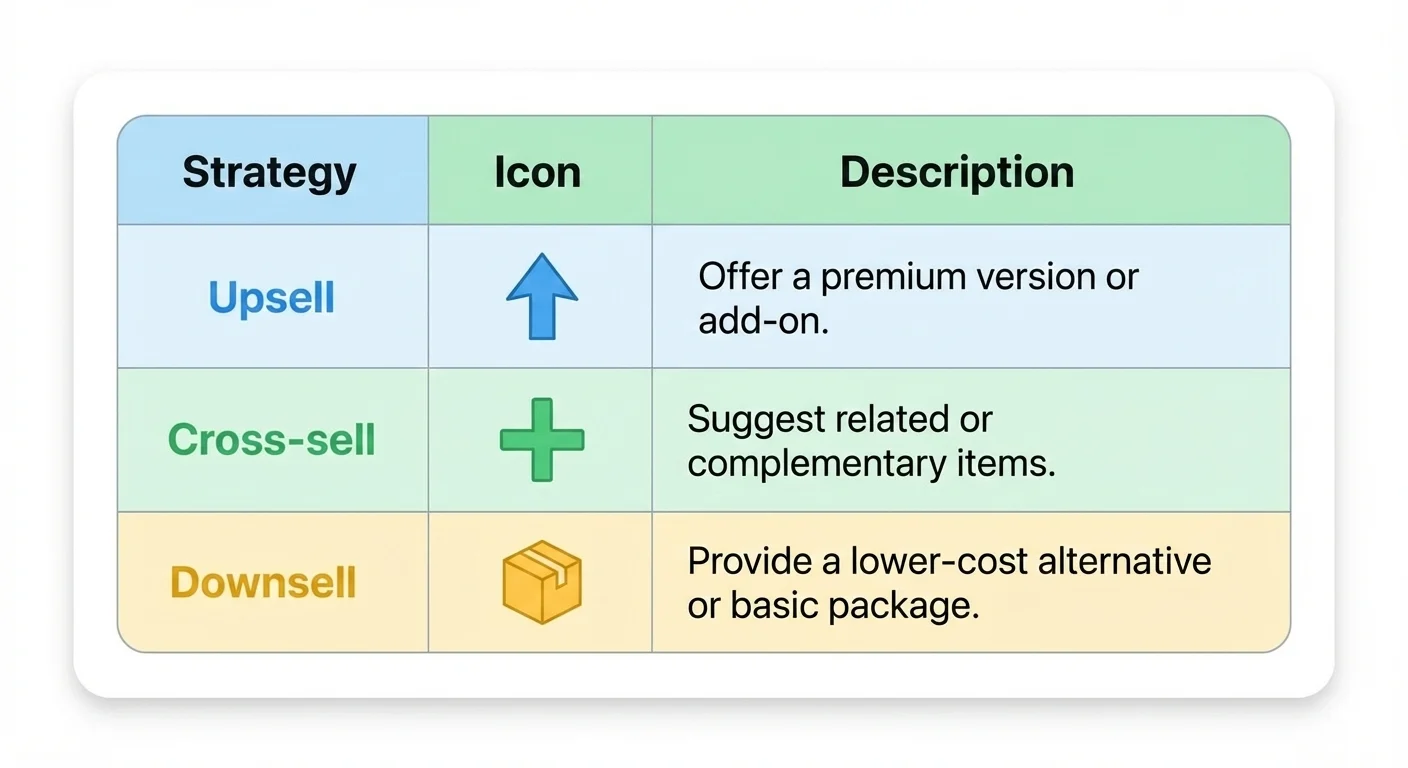
Upsell, cross-sell and down-sell are often used interchangeably, but they mean different things in the world of ecommerce. While upsell increases average order value, cross-sell strategies focus on adding complementary items to the same order. Let’s break down each one of them.
Why AOV Is Your Most Powerful Profit Lever
One reason upselling gets the attention of Shopify operators is because of the numbers that back it up. According to Forrester research, product recommendations including upsells, play a major role in improving customer lifetime value (CLV). It accounts for roughly 10–30% of total ecommerce revenue. McKinsey also reports that companies doing personalization will generate up to 40% more revenue than their peers.
But let’s make this practical. If your average order is $50 and just 15% of customers accept a $10 upsell, your AOV rises to $51.50. That extra $1.50 comes with almost no additional marketing cost, but from better timing and a better offer.
And because the sale is already happening, most of that revenue goes straight to profit. That’s why upsells don’t just grow revenue. They improve margins, stabilize cash flows and make rising ad costs easier to manage.
The Anatomy of a High‑Converting Shopify Upsell
The best upsell is a service, not a sales trick. When done right, upsells should improve customer’s experience while increasing your revenue. The best Shopify upsell strategies follow four simple principles that protect conversion rates while increasing order value.
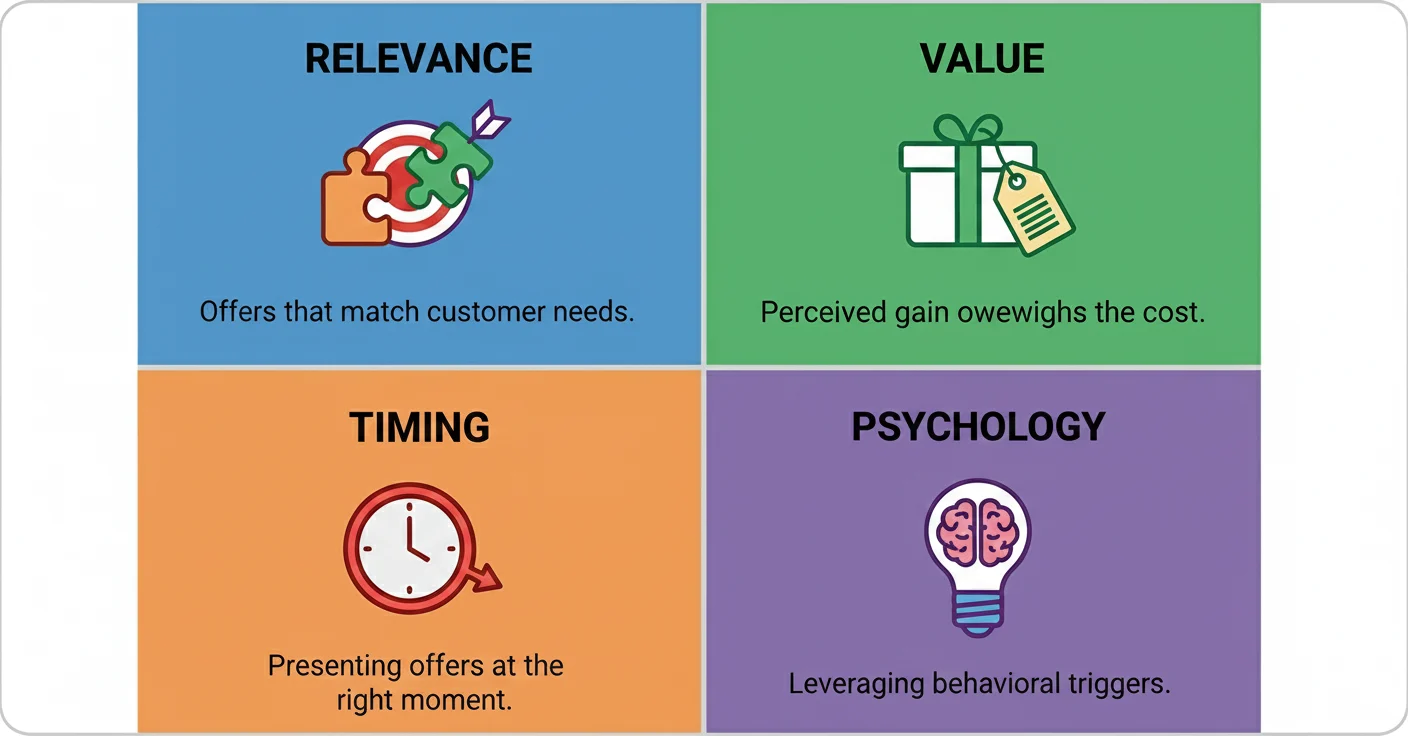
Principle 1: Relevance Comes First
An upsell should feel like the next logical step, not a random suggestion. If someone is buying a beginner product, show them the upgraded version. If they’re buying a single item, offer the bundle that completes it.
A good rule of thumb is the 25% guideline. Try to keep the upsell price within roughly 25% of the original product. A $100 product can comfortably upsell to $125. Jumping to $250 usually feels like a bait‑and‑switch.
Principle 2: Lead With Value, Not Price
Customers don’t resist upsells because they cost more. They resist upsells because the value isn’t clear.
Instead of saying:
“Upgrade for $20 more.”
Say:
“Upgrade to the family size and save 40% compared to buying later.”
By showing savings, convenience, durability, and long‑term value, customers tend to see more than raw pricing.
Subscriptions, warranties, and bundles work especially well here because the benefit is immediate and easy to understand. “Save 15% on every order” is easier to say yes to than “Pay more today.”
Principle 3: Timing Is Everything
Where you show the upsell is just as important as what you offer.
- Pre‑purchase upsells work well for upgrades and bundles
- In-cart upsells are great for small add-ons
- Post‑purchase upsells perform best for high‑intent offers that don’t interrupt checkout
Why?
Because the customer has already decided to buy. Right after checkout, trust is highest, friction is lowest, and the customer is already in buying mode. This is exactly why one-click post-purchase upsells outperform most other formats. They add value without interrupting checkout
Principle 4: Use Psychology Ethically
Good upsells guide the customer. This is why you need to study basic human behavior. Here are a few principles to help:
- Anchoring: Show the premium option first so the next option feels more reasonable
- Urgency: Limited‑time upgrades perform better than open‑ended offers
- Social proof: “Most popular choice” works because it reduces decision fatigue
When used sparingly, these cues guide decisions instead of forcing them.
At this point, the pattern should be clear. Upsells work best when they’re relevant, valuable, well-timed, and frictionless. And when you remove unnecessary steps, especially payment re-entry, conversion rates jump.
The Four Critical Stages of Upselling on Shopify
Effective Shopify upselling works best when it isn’t treated as a single moment in the buyer’s journey. Rather, it is a system that follows the customer from curiosity to checkout, until the post-purchase glow. Each stage has its role and rules. Together, they work to increase AOV. Let’s walk through them:

1. Product Page Upsells (Pre‑Purchase)
This is your first real opportunity to increase order value. At this stage, customers are researching and comparing options. Their intent is high, but their decision isn’t final yet. Your upselling here shouldn’t overwhelm them, but help them choose better.
Strategy: Product Bundles and Volume Discounts
Instead of selling a single item, offer a smarter option that includes more value at a slight discount. Bundles work because they simplify decisions and feel like a deal. The customer doesn’t have to think about what else they might need, you’ve already done that for them.
Example: A skincare brand offers a “Starter Kit” with one core product. Right beside it is a “Complete Routine Bundle” that includes cleanser, toner, and moisturizer, priced about 10% lower than buying each item separately.
Strategy: “Upgrade to the Pro” or “Frequently Bought Together”
This is the classic upsell that still works when done right. Here’s how it works:
Show the better version of a product clearly and explain the difference simply. Let the customer choose without friction.
Pro tip: Use toggles or radio buttons so customers can switch between versions without leaving the page. Fewer clicks means fewer drop-offs.
2. In‑Cart Upsells (The Decision Point)
In-cart upsells, often called cart upsells, work best when they’re small, relevant, and friction-free.Once an item is in the cart, the customer has mentally committed. But the transaction isn’t complete yet, which means friction matters more than persuasion. In‑cart upsells should be small, relevant, and easy to say yes to.
Strategy: Free Shipping Thresholds
This is the “just a little more” tactic. When customers see they’re only a few dollars away from free shipping, they’ll often add an extra item without hesitation. Instead of saying “Buy more,” you’re saying:“You’re almost there.” We recommend that you set your free shipping threshold slightly above your average order value and display a message like:
“You’re only $12.50 away from free shipping.”
Customers will often add something small just to clear the bar.
Strategy: Complementary Add‑Ons
These are checkout‑lane impulse buys that are not necessarily essential, but make sense to the buyer. For example, if someone is buying shoes, offer premium socks or a cleaning kit for a low price. The trick is to keep the prices low enough to feel effortless, but meaningful enough to move AOV.
3. Checkout Upsells (The Final Offer)
Checkout is a fragile moment, and this is where many merchants make mistakes. Customers expect a frictionless checkout, and interrupting that can lead to cart abandonment. That’s why the best Shopify stores in 2025 don’t upsell during checkout, but after it.
Strategy: Post‑Purchase One‑Click Offers
A Shopify post-purchase upsell appears after checkout but before the thank-you page. Because payment details are already processed, customers can accept the offer with a single click, without needing to fill any form or re-enter their payment details.
Pro tip:
Keep these offers exclusive or heavily discounted:
“Add a second item for 50% off”
“Limited-edition color, only available now”
This is where tools like Cart‑X shine. One‑click post‑purchase offers consistently outperform traditional popups because they respect the checkout flow instead of disrupting it.
Strategy: Subscription or Membership Upgrades
If you sell consumables, checkout is the perfect moment to introduce subscriptions.
Example: “Subscribe now and save 15% on this order and every future one.”
You increase today’s AOV and lock in recurring revenue.
4. Post‑Purchase Upsells (Retention and Loyalty)
The transaction is complete, but it’s the perfect time to continue the relationship. Post‑purchase upsells focus less on urgency and more on long‑term value.
Strategy: Thank‑You Page Offers
This is often called a thank you page upsell, and it works best for low-pressure follow-up offers. You can use it to offer:
- A discount on the next order
- A referral reward
- A relevant add‑on they might need later
Example: “Thanks for your order. “Share this link with a friend and you both get 15% off your next order.”
Strategy: Email and SMS Follow‑Ups
Trigger follow‑ups based on when the customer is likely to need the next product. For example, seven days after someone buys a printer, offer discounted ink cartridges.
Top Shopify Upsell Strategies for 2026
To win at upselling in 2026, Shopify merchants need to learn strategies that make upsell work. These strategies focus on personalization, timing, and trust. These are some of the highest-converting Shopify upsell examples and strategies we see across fast-growing stores
Strategy 1: AI‑Powered Personalization
Generic upsells are great, but today, they are easy to ignore. That means they won’t convert as you expect. Modern shoppers expect you to understand context and offer personalized services. AI-driven recommendations analyze browsing behavior, purchase history, and patterns to suggest the most logical next product.
If someone is shopping for premium leather goods, recommending a leather care kit makes more sense than a cheap plastic accessory. The result is higher conversion rates and customers that are satisfied with helpful recommendations.
Strategy 2: Post‑Purchase One‑Click Upsells
Post-purchase one-click upsell deserves special attention because it consistently delivers the highest ROI. Merchants using post-purchase upsells often see 10–15% conversion rates, significantly higher than pre-purchase popups. By moving the upsell after checkout, you remove the biggest risk: cart abandonment.
This is one of the reasons Cart‑X is built around frictionless, one‑click post‑purchase funnels. This helps merchants capture high-intent revenue without disrupting checkout or re-asking for payment details.
Strategy 3: Subscription Upgrades and Loyalty Tiers
Recurring revenue is one of the strongest growth levers in ecommerce. Instead of one-time wins, you build predictable growth by upselling customers from one‑time purchases into subscriptions, or from basic plans into premium tiers.
Pro tip: Make the value gap obvious. Early access, exclusive perks, free gifts. These should clearly outweigh the price difference.
Strategy 4: Ethical Upselling That Builds LTV
The best upsells make customers feel smarter, not sold to. If an offer exists only to squeeze more money, customers notice. If it genuinely improves their experience, they come back. Selling a necessary accessory separately feels deceptive. Offering a better version on the other hand feels helpful.
Long-term growth comes from customers who trust you. And trust compounds faster than revenue ever will.
Choosing the Right Shopify Upsell App for Your Store
Your strategy is only as good as the tools behind it. The best upsell apps help you:
- Launch fast
- Reduce friction
- Track what’s working
When evaluating tools, look for:
- One‑click post‑purchase upsells
- Flexible placement across product, cart, and post‑checkout pages
- A/B testing and clear analytics
- Mobile‑friendly design
Cart-X is designed around exactly these principles. It offers simple setup, no revenue fees, and a focus on post-purchase moments where conversions are highest.
Measuring Your Upsell Success
Upselling is a system that is measurable. These are the core metrics that you should track:
Track these core metrics:
- AOV: Are orders getting bigger?
- Upsell conversion rate: Aim for 5–15%, depending on placement
- CLV: Especially important if you run subscriptions
- Revenue per visitor: AOV improvements compound here fast
How to A/B Test Your Offers Effectively
A/B testing is non-negotiable. You should be constantly testing:
- Offer Type: Testing a discount vs. a free gift vs. a volume bundle.
- Placement: Testing an offer on the product page vs. the cart page.
- Pricing: Testing a 10% discount vs. a 15% discount.
- Copy: Testing benefit-focused copy ("Save 40%!") vs. feature-focused copy ("Get the 64GB model!").
Test one variable at a time and run tests for at least two weeks to capture real behavior patterns. This is where tools like Cart-X’s analytics dashboard earn their keep: showing exactly which funnels are pulling their weight.
Your Shopify Upsell Action Plan
In 2026, you shouldn’t be considering whether you should upsell. Instead, you should be planning how well you can position your upselling game strategy to yield more. In a world where rising ad costs continue to soar, margins, it’s how profitable stores stay profitable. Use this formula to get started:
- Audit your products: Identify three natural upsell opportunities for your best sellers.
- Implement post‑purchase upsells: One‑click offers are the fastest AOV win.
- Test and personalize relentlessly: Let data drive decisions.
When upsells are relevant, well‑timed, and frictionless, they don’t feel like selling. They turn your Shopify store into a sales machine that earns more from every customer.
If you’re ready to make your AOV a little less shy, Cart-X is built to help you do exactly that.
Don't miss out on expert e-commerce and marketing insights! Subscribe to our newsletter for valuable tips in just a few clicks.

.svg)


