
Bigger Orders, Better Profits: 7 Proven Ways to Boost Average Order Value by 25% in 2026
Ad costs keep rising. These 7 proven AOV strategies helped Shopify stores boost revenue by 25% without spending more. The profit math inside

If you run a Shopify store in 2026, you’re likely already spending more on ads than you did last year.
And while traffic may be bringing in orders, profit may not feel the way it used to. This is because customer acquisition cost (CAC) has become more expensive.
But there is a smarter way. Instead of fighting harder for new customers, you can focus on getting more value from the customers you already paid to acquire. That’s where average order value (AOV) quietly becomes your strongest advantage.
AOV is the most controllable lever in your entire business that doesn’t depend on algorithms. It only depends on how well you serve a customer when they are already buying. And once you increase AOV, your CAC begins to drop and scaling becomes achievable.
Let’s examine seven marketing techniques that help Shopify merchants increase average order value and extract revenue from the customers they’ve already paid to acquire.
Why AOV Is Your Most Profitable Metric
Average order value matters because of how it interacts with your costs. Having a proper understanding of how it impacts your business can make a huge difference.
Average order value is simply calculated as:
Average Order Value = Total Revenue ÷ Number of Orders
On its own, it looks basic, but the real impact becomes obvious when placed next to Customer Acquisition Cost. Consider a common scenario for a Shopify store:
- You sell a product for $50
- It costs you $20 to produce and fulfill
- Your gross profit is $30
- Your CAC is $25
After acquisition, fulfillment, and overhead, you’re left with $5 in net profit. Now imagine you increase that customer’s order value by an additional $5 added through a relevant upsell or cross-sell, the numbers will change:
- Order value increases to $55
- Gross profit increases to $35
- CAC remains $25, because the customer was already acquired
Your net profit moves from $5 to $10 on the same order. This lift in profit is what most stores overlook, but experienced Shopify merchants chase it. A 10% increase in AOV can produce a disproportionately large increase in net profit since acquisition costs are fixed per order. Once CAC is paid, every additional dollar in the cart carries a higher margin.
This is why AOV becomes the focus after traffic is working because this is where monetization efficiency begins to matter more. Upsells, bundles, and post-purchase offers directly target this efficiency because they increase revenue per transaction without increasing acquisition spend. They also ensure that stores protect margins and keep scaling sustainably in a high-CAC environment.
But here's the part most merchants miss: higher AOV isn't just about profit. It's about buying power. If your AOV is $75 and your competitor's is $50, you can afford to pay $40 for a click while they're capped at $25. You don't just win the sale—you win the auction. You control the traffic. Your competitor watches from the sidelines wondering why their ads stopped working.
7 Marketing Techniques to Skyrocket Your AOV
Now that you understand how AOV impacts your Shopify business, you might be wondering the best approach to improve it. We’ve compiled seven strategies that have been used across thousands of Shopify stores that you can copy. When used right, they can also help you improve customer experience.
Technique 1: Strategic Upselling & Cross-Selling (The Profit Engine)
Upselling and cross-selling are AOV levers that work because they meet customers mid-decision. They both happen when the customer is in buying mode, and when the upsell or cross-sell product popups, the intent is already there. You are not convincing them to buy, but you’re helping them to buy better.
While these two can boost AOV, many stores make the mistake of introducing them early when they interrupt checkout and add friction; friction kills conversions faster. That’s why many pre-purchase upsells feel risky. Legacy apps also suffer from visibility issues with ad blockers, meaning up to 30% of customers never see the offer. A smarter move is to adopt post-purchase upselling.
By placing an upsell after transaction is complete, you create an atmosphere where the customer is relaxed and is open to adding one more thing to their initial purchase. This reason is why post-purchase upsells routinely convert up to 4-10%, which is higher than in-cart offers because they carry zero risk to the original sale.
Pro-tip: start with one post-purchase offer that clearly complements the original product. Keep it under 50% of the initial purchase price and highlight how the upsell helps the initial purchase. Need help setting this up? See our step-by-step guide to implementing your first upsell.
Cart-X automates this moment with frictionless, one-click post-purchase upsells that feel like a continuation of the purchase and less like an interruption. Because it's built on native Checkout UI Extensions, it offers load in under 200ms without slowing your checkout.
Technique 2: Dynamic Free Shipping Thresholds
Free shipping is more than a perk. It is a psychological goal. When a customer sees a message like "You’re $18 away from free shipping," they stop thinking about spending and start thinking about solving a problem.
The data here is hard to ignore. FedEx found that 81% of shoppers will actually spend more just to hit a shipping threshold. It comes down to mental accounting. Paying $10 for shipping feels like losing money, but buying a $15 accessory to "unlock" free shipping feels like a win. In both cases, the customer spends roughly the same amount, but the emotional outcome is completely different.
To make this work, you have to be strategic with your numbers. Set your threshold about 10% to 30% above your current AOV. If your typical order is $75, then $99 is a perfect target. It is close enough to feel reachable. However, if you set it at $150, most people won't even try.
You should also make this goal visual. A progress bar in the cart that updates in real time works because humans have a natural urge to finish what they start. As they add items, that bar fills up. Every addition feels less like a cost and more like progress toward a reward. This simple visual nudge is often the difference between a single-item order and a multi-item cart.
Technique 3: High-Value Product Bundles & Kits
Bundles work because they reduce decision fatigue. Instead of asking customers to choose five things, you give them one good answer. A skincare brand for example can choose to sell cleanser, toner, and moisturizer as a Starter Routine, instead of separately. The same goes for a coffee brand that sells a Brew-at-Home Kit, not just beans.
In summary, a great bundle should:
- Solve a complete problem
- Feel curated, not random
- Cost slightly less than buying items individually
Examples of these include:
- “Starter Kit”
- “Essentials Pack”
- “Everything You Need”
But here's where 2026 merchants are winning: customizable bundles. Pre-set kits work, but "Build Your Own Bundle" works better. Customers hate being forced into products they don't want. A skincare bundle that includes a toner they already own feels wasteful. But a bundle builder that lets them choose their cleanser type, select their moisturizer, and skip what they don't need? That feels tailored.
BYOB increases AOV by giving customers a sense of agency while still hitting your target spend threshold. You set the framework: "Choose 3 products, get 15% off," and let them customize within it.
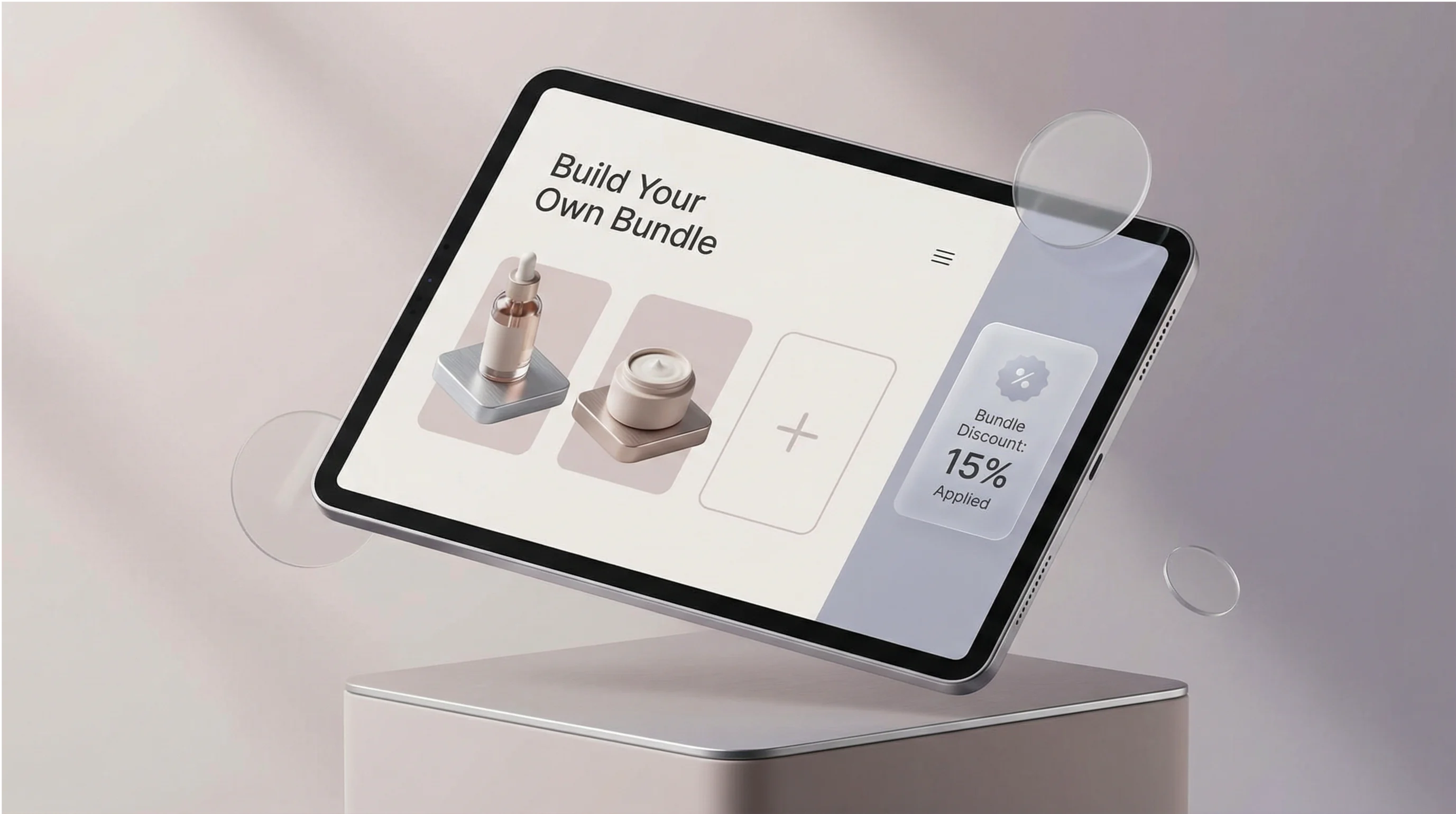
If you’re considering implementing this, start by building bundles around outcomes. Ask this question: “What does my customer want to achieve faster?” Then build bundles around that answer. Remember that bundles increase the unit per transaction and make checkout feel easier
Check our guide on the best upsell combinations to sell on Shopify
Technique 4: Tiered Volume Discounts (Restock Incentives)
Volume discounts work when customers already expect to reorder. They work for consumables such as supplements, beauty, pet products, and food. So instead of discounting upfront, you can reward commitment
- Buy 1 for full price
- Buy 2 for 10% off
- Buy 3 for 15% off
This structure helps customers consider stocking up in order to unlock the discount. At the same time, your AOV rises and future CAC drops because reorders take longer.
Technique 5: Gamified Loyalty Milestones
Asides driving retention rates, loyalty programs also increase order size. This is because when customers are close to a reward tier, spending a little more to reach the next level feels logical and satisfying.
Example:
“Spend $100 total to unlock Silver status and get free shipping on future orders.”
Pro-tip: Set your first milestone slightly above your average order value. Give customers a reason to stretch just once. Also place milestone messaging in-cart and post-purchase so shoppers can easily see them.
Technique 6: The Post-Purchase High
Right after checkout, customers experience what psychologists call commitment bias. They’ve made their decision to buy and they’ve grown a level of trust for your brand. Also, their card is still warm. This is the Dopamine Window, and it closes fast. This period is one of the most underused moments in ecommerce. For you, it can be the perfect time to include offers that are:
- Highly relevant add-ons
- Discounted of limited-time framed
- Acceptable with one click
Add to these a frictionless checkout that requires no extra form-filling. This is where Cart-X becomes your strategic ally. It provides you a seamless one-click post-purchase offer that enriches customers’ experience.
Technique 7: Threshold-Based Incentives
Sometimes a gift beats a discount. Having a headline that says “Spend $150, get a free premium case” often converts better than “Save $15” even when the value is similar. Why? Because tangible rewards feel like wins.
The key rule is to choose gifts with high perceived value, but with low actual cost. Also ensure that incentives are visible on product pages and carts, so it influences behavior before checkout.
The Cart-X Advantage: Automating Your AOV Growth
Trying to implement all seven AOV techniques manually requires a lot of work and tools. And many of these tools come with their own learning curve and monthly fees, making scaling almost impossible.
This is where automation becomes an essential element if you want to achieve results. Many stores use Cart-X to handle the highest-impact and lowest-risk AOV techniques including strategic upselling, cross-selling, and post-purchase offers. It focuses on these parts because they are the moments where customers are most likely to say yes.
Not every AOV tactic needs to live inside one tool. Free shipping thresholds, loyalty programs, and bundles often sit at the store or catalog level. That’s fine. Cart-X focuses where the returns are clearest: direct, transactional moments tied to a real purchase decision.
Here are some reasons Cart-X works well:
Zero-Risk Post-Purchase First
Cart-X places upsell offers after the initial payment is complete. That means your core conversion is locked in before any additional offer appears. That way, you don’t risk disrupting checkout or having carts abandoned.
True One-Click Acceptance
Customers don’t need to re-enter payment details to accept offers. This reduces the chances of them rethinking the purchase. They click once and the item is added in one frictionless process.
Smart Automation, Not More Work
You can build smart funnels that run in the background like these:
- If someone buys Product X, offer Product Y at 20% off
- If they decline, offer Product Z at 10% off
- If they accept, stop there and end on a good note
You set it up once. It keeps working automatically. This is important because AOV optimization works best when it’s consistent.
Conclusion
Increasing your Average Order Value is a response to reality. With increasing ad cost and market competition, chasing more traffic without improving monetization can become exhausting. Stores that survive are the ones that understand that growth without profitability is just expensive practice.
By applying the seven techniques in this guide, you shift your store from being a traffic-dependent model to being profit-first. You also stop relying on acquiring new customers and getting more value from the customers you’ve already earned.
If starting everything seems overwhelming, start with the simplest, but effective strategy: post-purchase upselling. Automate it with Cart-X so that layering bundles, incentives and loyalty becomes easy.
Ready to put your AOV to work? Start your free trial of Cart-X and automate the most profitable moment in your funnel.
FAQ
How can I increase AOV without offering discounts?
Focus on bundling and value-based incentives. Product kits and free gifts increase perceived value without lowering your core pricing.
What’s a realistic AOV increase after implementing these strategies?
Most Shopify stores see a 10–25% lift simply by moving from no upsells to post-purchase one-click upsells.
Does increasing AOV hurt my conversion rate?
It can if upsells interrupt checkout. Post-purchase offers don’t. Because the initial transaction is already complete, they have zero negative impact on your base conversion rate.
Which AOV technique should I start with?
Post-purchase upselling. It requires the least technical setup, carries no risk to existing conversions, and delivers immediate, measurable results. Once that's working, add free shipping thresholds and bundles.
How do I know if my AOV strategy is working?
Track two metrics: AOV (obviously) and net profit per customer. AOV can increase while profit decreases if you're discounting too heavily. Monitor both to ensure you're actually making more money per transaction.
Don't miss out on expert e-commerce and marketing insights! Subscribe to our newsletter for valuable tips in just a few clicks.

.svg)


